A short guide to high efficiency motor selection for system designers
Key Highlights
- Motor sizing should balance output, efficiency, and lifecycle cost—not just upfront performance—to avoid hidden energy expenses.
- Efficiency losses (I²R, core, friction, stray) drive heat and cost; reducing them improves performance and reliability.
- Higher efficiency motors cut energy use but add cost/weight—selection must align with duty cycle, budget, and application needs.
- Upgrading motors isn’t plug-and-play; speed changes can raise load—optimize the full system (e.g., VFDs, belts) for real gains.
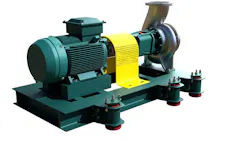
When designing industrial equipment or selecting a component for a specific application, a solid understanding or intuition of operating principles is a great asset. This is particularly true when selecting the prime mover, which for many industrial applications is a three-phase squirrel-cage induction motor.
Electric motor selection has a profound impact on energy requirements and long-term energy consumption, so it is key to understand the factors that drive electric motor efficiency and their respective ratings. Beyond operational costs, motor efficiency can deeply affect a system’s functionality.
Thankfully, the process of selecting an electric motor has been made easier by standardization initiatives from associations like NEMA and the IEC. Perhaps the most important standardization was of motor frame size, whose impact cannot be overstated. Likewise, the standardization of motor efficiency classification has greatly simplified the motor selection process. This simplification, however, should not distract from the importance of understanding the fundamental operating principles behind this technology. Rather, it should serve as a tool to improve productivity.
The impact of sizing on motor efficiency
One complication when discussing motor efficiency can be the sizing conventions typically used. Unlike other devices, motor sizing is based on mechanical output power, not on the energy consumed. NEMA-rated motors are often sized in horsepower (hp), and IEC-rated motors in watts (W). Where 1 hp is equivalent to 746 W, new designers can be excused for confusing energy delivered with energy consumed.
The same could be said for the tunnel vision that can occur during the sizing process. Power consumed and efficiency are often less of a priority than delivered mechanical energy, and any additional operational costs that result are borne by the end user. With designers and equipment manufacturers under pressure to optimize upfront cost vs. performance, operating costs are not always duly considered during the project’s design phase.
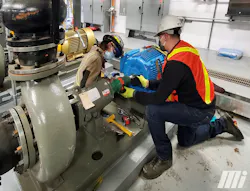
Types of motor energy losses
When discussing motor efficiency, it also is prudent to contextualize how energy losses are generated. Although a motor’s efficiency rating provides an overall basis for comparison, it is the losses inherent to the design that ultimately drive this rating. These losses result from several factors but are often categorized as stator loss, rotor loss, core loss, frictional and windage loss, and stray load losses—all leading to heat generation:
Stator resistance loss is the largest of these contributing factors, followed closely by rotor resistance loss. Both can be characterized by the equation PLoss = I2R.
Core losses are primarily caused by the induced eddy currents and magnetic hysteresis resulting from the changing magnetic fields within the motor’s core.
Friction and windage losses are attributable to the shaft bearings (friction) and the aerodynamic factors related to the spinning rotor and motor fan (drag).
Stray load losses are a catch-all category for all other losses that can occur. They are primarily caused by manufacturing defects, material defects and harmonics (resulting from VFD use) and are often dependent on motor loading. These issues can lead to problems of circulating currents, flux non-uniformity or interlaminar currents.
Alternatively, these losses can be categorized as ohmic (stator and rotor loss), mechanical (frictional and windage), iron (hysteresis and eddy currents), and stray (everything else).
How do motor manufacturers combat efficiency losses?
Understanding the issues that cause efficiency losses leads to the next logical question: What can motor manufacturers improve to combat them? The answer is both simple and complex. In short, efficiency is enhanced by reducing resistance, improving the quality of the materials used, and increasing the accuracy level throughout the manufacturing process. These marginal improvements can have meaningful impact.
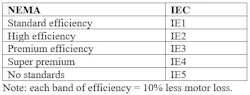
Table 1 outlines the IEC and NEMA rating conventions, illustrating how they align. Each step in classification will deliver 10% fewer losses. Although NEMA doesn’t have a rating comparable with IE5, some motor manufacturers are labeling motors with efficiencies higher than “Super Premium” as “Ultra-Premium.”
Motor efficiency increases come at the cost of increased weight and price. The increase in weight can be primarily attributed to efforts in reducing resistance. To accomplish this, larger conductors—and thus more conductor material—are required for efficient conduction within the motor. For equipment designers and manufacturers who integrate motors as part of an assembly, this higher upfront price and additional weight must be balanced against many factors to determine the suitable efficiency class, based on the application’s requirements. Although higher efficiency would intuitively seem like the obvious choice, this is not always the case.
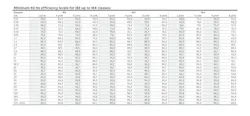
Table 2, based on the IEC 60034-30-1 standard, outlines efficiency ratings for IE2 and higher classifications. One thing that should stand out immediately is that the larger the kW rating, the higher the baseline efficiencies. This is due to economies of scale, as energy losses will not scale up in direct linear proportion to the motor’s power ratings. It is helpful to also remember that a motor’s efficiency will likely be dynamic throughout its loading curve. Peak efficiency will typically occur somewhere between 50% and 100% of the loading range.
Two examples of weighing efficiency factors when selecting an electric motor
To help illustrate some of the factors that must be balanced when specifying a new motor, let’s consider a hypothetical example where our application requires a motor that can deliver 15 kW of mechanical energy. Based on the data in Table 2, if we select a 4-pole motor, it will mean 91% eff (efficiency) for IE2, 93% eff for IE3, and 94.1% eff for IE4. To examine a continuous-duty application, we will assume the application runs 24/7 (8,760 hours per year) with a $0.10 per kWh cost. Comparing and applying the above efficiencies, that would mean:
kW Hrs = (Rated kW x hours of operation) / eff

If we estimate the equipment’s service life to be 10 years or more, this application could easily pay for itself with the IE4 motor’s energy savings. However, these savings are typically only realized by the end user. Buyers can face real-world limitations that create split incentive structures. Perhaps their capital projects or maintenance budget is limited. Or, maybe the buyer is not tied to operating budgets and is thus not motivated by potential savings. Perhaps this is for a mass-produced application, and the competitive nature of the market means reducing upfront costs is the key consideration. Or, it is a mobile application, and weight is most important, or the motor’s duty cycle is less than 30 minutes a month. As you can see, specifying a motor is not as straightforward as it appears.
Also, when selecting a motor for existing applications, it may seem intuitive to simply replace an existing failed motor with a higher-efficiency model—but that is not always the ideal solution. Consider a second example, a fan application that has been in service for several decades, where the original motor ran at or below NEMA Standard efficiency (or IE1). For such an application, it is critical to consider that higher-efficiency motors typically run faster (have less slip).
For fan applications, this speed difference can’t be overlooked, as fan and pump loading are governed by affinity laws (i.e., effects by changes in motor speed). For our application, a 1% increase in speed can lead to a 3% increase in loading. Therefore, when upgrading from a 1740 rpm motor to one at 1760 rpm, the power increase can wipe out any potential savings from upgrading efficiency ratings.
Rather than a single swap, a holistic review of the application could be warranted, particularly for higher-horsepower applications. In such a review, you may find that the application was oversized from the beginning or that a v-belt could be upgraded to a synchronous belt to further improve efficiencies. Given the age of the application, it might also be utilizing a magnetic motor starter. Installing a VFD in combination with the motor and upgraded belt drive provides a multi-faceted approach to upgrading the design while substantially reducing power consumption.
In conclusion
As with most design-related topics, there is much nuance, and a “one-size-fits-all” approach is rarely the ideal strategy. Understanding the first principles and the factors that govern equipment operation is critical. As equipment designers develop and grow, they build a fundamental understanding of these operating principles—which evolve into designing with a more simplified and elegant approach. When evaluating motor efficiency classes, this foundational understanding should always be your governing principle.
About the Author
Ian Miller
Based in Calgary, Ian Miller, P.Eng., is a division manager for Motion Repair & Services. With 20 years of industry experience, his current responsibilities include oversight and development of 12 repair/service centers focusing on fluid power, automation and material handling. Miller is passionate about providing top customer service through technical expertise and added value. For more information, visit motionind.biz/4dT5v03.