What is Coriolis flow measurement?
Key Highlights
- Coriolis meters deliver ±0.1% mass flow accuracy independent of fluid properties, improving measurement reliability across varied processes.
- Multivariable outputs (flow, density, temp) reduce instrumentation needs and enable predictive maintenance via diagnostics and digital data.
- High turndown, no straight-run piping, and versatility make them ideal for tight spaces, hydrogen, custody transfer, and complex fluids.

Coriolis flowmeters are so named because they rely on the physics concept of Coriolis force. Inside these instruments, one or more tubes are oscillated at a frequency induced by pulses from an exciter.
As gas or liquid process media flows through each tube, its inertia imposes additional twisting, changing the oscillatory pattern. Two detectors—one upstream and one downstream of the exciter—distinguish this phase difference, which directly correlates to mass flow, providing a highly accurate and direct measurement that is independent of process media properties (Figure 1).

The mechanics of this method—paired with onboard calculations performed electronically by the instrument transmitter—provide multiple process values for consumption by a host controller, including mass flow, temperature, density, volumetric flow, corrected volumetric flow, and others. This consolidation of measurement tasks reduces the complexity and cost of installing multiple instruments, while providing a more holistic view of a process by making the various datapoints available to host systems. In systems that leverage these capabilities, digital communication protocols significantly ease data transmission for monitoring plant process loops.
What are the key advantages of using Coriolis flowmeters?
Coriolis flowmeters are characterized by their high accuracy, typically within ±0.1% of the true value or less, and they remain accurate regardless of physical fluid properties and flow profile.
In addition to multivariable measurement and outstanding accuracy, today’s leading models provide onboard instrument health diagnostics, along with in-situ verification procedures, both of which help plants optimize their processes and operate profitably in a multitude of industries. These data, both raw and conditioned, provide invaluable information that is useful for preemptively identifying process issues, implementing predictive maintenance, and informing production decisions to promote long-term operational stability. This information also helps plant personnel detect issues that can cause shutdowns or failures, reducing both safety incidents and downtime.
Many modern Coriolis flowmeters also provide onboard interfaces, along with options for wireless configuration via apps for mobile devices.
What are additional characteristics of Coriolis meters?
Rangeability, or turndown, with mass flowmeters is typically very large compared to volumetric-only variants, which facilitates use of a single meter in many applications, even those with widely varying flowrates. Additionally, Coriolis flowmeters do not require straight upstream and downstream pipe runs like other types, making them ideal for use in tight spaces. Many flowmeter variants have these straight-run requirements to stabilize the process media’s flow profile for accurate measurement.
When the tubes in a Coriolis meter are excited, they naturally oscillate at the resonance frequency. This resonance frequency is based on the mass of the tube and the product inside it, and since the tube mass and volume are fixed, any change in resonance frequency is attributed to a change in fluid density.
What industrial applications are best for use of Coriolis flowmeters?
Coriolis flowmeters excel at measuring mass flow across a multitude of fluids, including solvents, fuels, crude oils, vegetable oils, gases, and liquefied gases. Because of their excellent measurement accuracy and reliability, along with limited maintenance requirements, Coriolis flowmeters are often preferred for measurement in these applications.
Coriolis flowmeters are also well suited for:
- Ultra-pure water flow measurement: This process media is prevalent in the life sciences and semiconductor manufacturing industries. Ultra-pure water conductivity is extremely low, rendering electromagnetic flowmeters—which are otherwise popular in these industries and perform well—with some challenges.
- Hydrogen metering: The low density of hydrogen gas compounds the inaccuracies of converting volumetric flow to mass because even seemingly small errors can result in large flow reading corrections. As the demand for hydrogen grows globally, high pressure may become increasingly common, further intensifying errors. It is typically easier to measure fluid flow at high pressure, but measuring hydrogen before it is compressed yields a more accurate result.
- Custody transfer: These applications often carry stringent accuracy standards of less than 0.2% uncertainty, and most flow measurement technologies available are incapable of meeting such precise requirements.
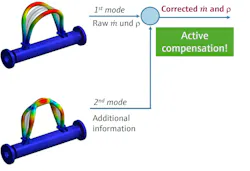
- Processes with entrained gases: Certain Coriolis flowmeter models equipped with electronic multi-frequency technologies can drive the tubes at their second and third natural modes to obtain additional information about a fluid’s vibrational properties (Figure 2). This increases the accuracy of mass and density measurements, most prominently in fluids with suspended gas bubbles, providing higher accuracy than most other flow measurement technologies. Entrained gas influences the fundamental and auxiliary resonance modes differently, and analyzing multiple modes together enables identification of entrained gases’ unique properties to compensate measurement accordingly.
Regardless of the industry, instrument specification and selection should consider holistic aspects of the target application to prepare plants for operational success. Coriolis technology’s precise multivariable measurement across a wide variety of liquid and gaseous process media provides quality assurance and operational flexibility, which are critical characteristics for driving production, increasing profits, and helping processors remain competitive.
About the Author
Lauton Rushford
Lauton Rushford is a national marketing manager for flow products with Endress+Hauser USA. He graduated from Purdue University in 2018 with a Bachelor of Science in nuclear engineering and joined Endress+Hauser shortly thereafter as an inside sales engineer. Throughout his eight years with the company, he also held a regional industry management role focusing on solutions in the water and wastewater industry.