Compressed air controls: Strategies for improving reliability and equipment life
Key Highlights
- Centralized control systems coordinate compressor operations, reducing energy waste and balancing equipment wear.
- Pressure band control tightens pressure setpoints, minimizing unnecessary cycling.
- Run-hour balancing extends compressor lifespan by rotating operational loads.
- Automated scheduling cuts energy costs by shutting down compressors during non-production hours, often saving up to 20%.
- Continuous monitoring verifies control effectiveness and supports proactive maintenance to prevent costly failures.
Compressed air controls do more than keep compressors running. Centralized control systems can coordinate pressure, compressor sequencing, run hours and operating schedules across and entire system. This gives maintenance and reliability teams a direct way to reduce energy waste, balance equipment wear and stabilize production. When controls and continuous monitoring are paired, facilities can verify that the system is still operating as intended.
3 control strategies that improve compressed air performance
In continuous compressed air processes, small inefficiencies compound over time into real operating costs. Of the levers a controller manages, pressure band control has the most direct impact on system performance, whereas the other two—run-hour balancing and scheduling—extend and reinforce that gain.
Pressure band control: System controllers can tighten the gap between high- and low-pressure setpoints. Narrowing that band reduces unnecessary load and unload cycling, stabilizes downstream pressure, and lowers the energy required to maintain target pressure. It also allows for gradual, deliberate pressure reduction in a way that’s difficult to achieve otherwise. Trying to walk down pressure across four compressors, each running its own independent band, means coordinating four separate targets at once, usually manually. Networked under one controller, they act as a single system with one band to adjust, so pressure can be lowered slowly and directly instead of chased machine by machine.
Run-hour balancing: Rather than letting one compressor carry most of the operating load while others sit idle, a system controller rotates operation across the full compressor lineup to equalize wear. In one documented case for a wood and lumber facility, this approach reduced run hours by 45 to 52% per unit compared to uncontrolled operation, directly extending service intervals and avoiding an estimated $28,000 in annual maintenance costs. Aligning run hours across the lineup also means service intervals across units stay predictable and close together. This way, maintenance visits can be coordinated into fewer, better-planned trips instead of chasing whichever compressor happens to hit its threshold first.
Scheduling: According to Compress Air & Gas Institute (CAGI), most compressed air systems operate at or near full capacity only 36 to 60% of the time. Automated scheduling that shuts compressors down during nights, weekends and other non-production hours fills this gap directly. This simple action can reduce energy bills by up to 20%.
Why centralized control matters in mixed compressor systems
Most facilities don’t run a single-brand, single-vintage compressor fleet. Systems evolve over years, and units are added and replaced. Different manufacturer platforms often produce data in formats with no unifying view. For facilities managing multiple compressor rooms or a mixed-brand estate, this fragmentation multiplies.
Sites often accumulate separate controllers, dashboards, portals and service reports. Each answers a different, narrow question, leaving the facility to ask who is accountable for the outcome. More tools don’t automatically mean more improvement.
Before adding controls or monitoring hardware, a proper system assessment should be performed to establish achievable, data-based objectives. This assessment must look at the estate holistically rather than one compressor room at a time. An expert can look across the entire mixed-brand picture and tie it back to outcomes, not just the health of individual units.
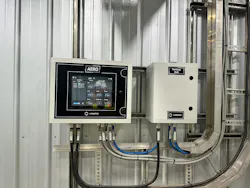
As a general guideline, once a facility operates more than three compressors, a centralized system controller becomes critical to achieve efficient, coordinated operation (Figure 1).
Monitoring verifies that controls are working
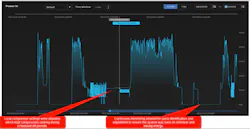
A controls project is different from a monitoring program, but they can work together. For example, at one manufacturing facility, a compressed air system controller was programmed with a strict operating schedule, shutting compressors down during nights and weekends when the plant was not in production. Weeks later, local settings on individual compressors were manually adjusted, overriding that schedule and causing units to run when they should have been off.
Because the system was continuously monitored rather than checked periodically, the deviation was identified and corrected before it produced any meaningful energy waste. Controls establish the right behavior once, but only continuous monitoring (Figure 2) confirms that behavior is still happening three, six or twelve months later. For maintenance managers, the ROI on that visibility is measured in avoided waste and avoided unplanned repairs.
Using monitoring to reduce maintenance risk
An air system controller replaces a room full of independent decision-makers with one coordinator. It sequences compressors, manages capacity control and reduces the need for manual intervention. Well-intentioned but uncoordinated adjustments to individual compressors commonly cause system underperformance, and centralizing control reduces that risk.
A controller uses a handful of reliable inputs like pressure to drive predictable sequencing—rather than carry the trend logs and connectivity that a monitoring program depends on. That’s what keeps the control side dependable. Monitoring is where the “something’s changed” signal belongs. A monitoring system identifies anomalies, such as a compressor cycling more than expected, a pressure band drifting or a unit running outside its scheduled operating window.
Demand-side evaluations follow the same logic. Tracking air demand during non-production hours, when there should be little to no legitimate demand, makes it possible to catch abnormal usage patterns as they emerge instead of waiting for a scheduled walk-through. Rising demand outside of production hours points directly to something worth investigating, like a piece of equipment left running, a process operating outside its normal parameters or a component starting to fail. Evaluations allow teams to prioritize investigations based on real data instead of guesswork.
Compressed air controls and energy efficiency
Compressed air is sometimes called the fourth utility, and like any utility, waste in the system shows up directly on the energy bill. Industry estimates from CAGI suggest that poorly designed or maintained compressed air systems account for as much as $3.2 billion in wasted utility payments annually in the United States, with average leak rates in manufacturing facilities reaching as high as 30%. Leaks, artificial demand caused by operating at unnecessarily high pressure, and inappropriate use of compressed air for tasks better suited to other power sources are the three primary sources of that waste.
For facilities pursuing sustainability and emissions targets, the math is compelling. Optimizing a single 200-hp compressor system can generate more than $30,000 in annual energy savings, while reducing CO2 output by roughly 269 metric tons. This is comparable to taking several city buses off the road for a year. Beyond the dollars, the same data that drives these savings gives facilities something else they increasingly need: evidence-led answers on where their carbon and sustainability commitments actually stand, rather than estimates. When approached this way, preventive maintenance and energy management stop competing for budget and attention and become the same initiative.
Best practices for compressed air controls and monitoring
Technology alone doesn’t ensure program effectiveness. The following best practices make the difference:
- Have a qualified compressed air professional complete a full system assessment before adding controls or monitoring hardware.
- Establish baseline performance data—pressure, demand, run hours, energy draw—for every critical compressor and system component.
- Standardize scheduling based on actual, measured demand profiles rather than assumptions about production hours.
- Correlate monitoring data with maintenance records to validate failure modes and prioritize repairs based on evidence.
- Treat monitoring as an ongoing program, not a one-time installation. The value compounds only when it’s continuously reviewed and acted on.
What’s next: Controls that anticipate demand
Everything above describes what a well-implemented control and monitoring program delivers today. However, the technology itself is still advancing quickly. A newer generation of control systems is starting to use production schedules and demand history not just to react to changes, but to anticipate them. They adjust capacity ahead of a swing instead of after one. That capability isn’t standard in most compressor rooms yet, and it’s early enough that it’s more direction than deliverable. But it points toward where the industry is headed: a controller that doesn’t just hold pressure and sequence compressors but anticipates compressed air needs. As monitoring data gets richer and more connected to production systems, that kind of forward-looking control is likely to become more common. It builds on the fundamentals of pressure stability and reliable sequencing, not replacing them.
When compressed air monitoring and controls are implemented together—and treated as a loop rather than a one-time project—compressed air becomes a measurable driver of reliability, cost control and sustainability. It’s the ongoing pairing of control and visibility, revisited on a regular cycle, that protects those gains, catches deviations before they erode results, and keeps ownership of the outcome clear instead of scattered across a stack of disconnected tools.
About the Author
Erik Shaw
Erik Shaw is a sales manager at Motion, leading an Onsite Solutions team focused on reliability, sustainability and storeroom optimization across industrial operations. For 15 years, he has worked alongside maintenance and reliability professionals to identify performance gaps and build data-driven solutions that deliver measurable results.