Ask the Experts: Reducing compressed air waste through smarter controls and system design

In this Ask the Experts feature, which runs regularly in Plant Services, expert instructors from the Compressed Air Challenge (CAC) tackle questions on compressed air systems and associated technology.
The Compressed Air Challenge, an educational foundation administered by the Compressed Air & Gas Institute, is a voluntary collaboration of industrial end-users; manufacturers, distributors, and their associations; trade organizations; consultants; state research and development agencies; energy efficiency organizations; and utilities. The CAC has one purpose in mind—helping facilities enjoy the benefits of improved performance of compressed air systems.
Question: Besides leaks, what is the most overlooked source of compressed air system waste in industrial plants?
1. Compressor Control
Paul Shaw, Middletown, CT:
In my opinion, one of the most overlooked sources of energy waste in large compressed air systems is part-load operation, both in single and multiple compressor systems. I frequently see systems with too many compressors running at part load, whether in modulation, or load/unload mode without adequate storage to support efficient operation. In many cases, customers don’t recognize they have an issue. Their primary focus is maintaining plant pressure and avoiding downtime. While that’s understandable, it often leads to significant and unnecessary energy penalties. Either they aren’t aware of the inefficiency, or they lack the knowledge or controls needed to manage it effectively.
For example, I visited a plant that required three 150 hp compressors to meet demand, yet they were running five units, with two additional compressors kept online “just in case.” That extra capacity came at a high cost, those two additional units consumed $200,000 per year including the cost of maintaining them. A system review revealed that the root issue was insufficient storage receiver capacity, which limited the system’s ability to maintain pressure during events like a compressor starting or a sudden demand spike. Because there wasn’t enough storage to bridge these gaps, the operators relied on keeping extra compressors online as a quick fix.
Once additional storage was installed and system controls were optimized, they were able to shut down the extra compressors with confidence. The system could now handle the loss of a unit or a sudden surge in demand without dropping below critical pressure levels, as standby compressors could start and respond in time.
Although many factors can contribute to part-load energy waste in a compressed air system, the following strategies can help reduce it:
- Right-size compressors for the application to avoid inefficiencies caused by oversizing.
- Evaluate system storage capacity to ensure it meets CAC (Compressed Air Challenge) and CAGI (Compressed Air and Gas Institute) guidelines. Adding pressure flow controllers can help stabilize the system and prevent operating at unnecessarily high demand-side pressures.
- Incorporate variable frequency drive (VFD) compressors as part of your strategy. In multiple compressor systems, a properly sized VFD unit can function effectively as a trim compressor—but correct sizing is critical to avoid control gaps.
- Work with a qualified compressed air system specialist to assess and data log your system, then partner with them to develop a targeted plan for reducing energy waste.
Jan Hoetzel, Grand Rapids, MI:
Beyond leaks, one of the most overlooked sources of waste in compressed air systems is ineffective control. Most plants focus on the traditional four dimensions—supply, demand, storage, and distribution—but overlook what can be considered the 5th dimension: control strategy. Relying on basic sequencing often results in compressors running inefficiently, with excessive unloaded time, pressure instability, and machines working against each other.
To truly drive efficiency, plants must take automation to new levels. An installed master controller goes far beyond simple sequencing. These often use adaptive learning logic and integrated monitoring to continuously evaluate system demand, compressor performance, and pressure conditions. Instead of reacting, controllers can proactively determine the optimal combination of compressors and operating points—ensuring each machine runs in its most efficient range while minimizing energy waste.
Equally important, integrated monitoring provides full system transparency. Operators gain real-time insight into performance, energy consumption, and trends, enabling proactive decision-making instead of reactive troubleshooting. By elevating automation to a higher level, end users gain what they truly need: a compressed air system that operates efficiently, reliably, and intelligently.
Tom Taranto, Baldwinsville, NY:
The most overlooked waste is not compressed air consumption. The most overlooked waste is lack of a “systems approach” to ensure you have an efficient control strategy, appropriate pneumatic energy storage, good system design, and machines that operate in a way that optimizes compressed air generation efficiency. Conversely, focusing on generation efficiency without optimizing demand side use of the compressed air produced, simply wastes compressed air efficiently.
We recommend using the “Systems Approach” addressing these areas:
- Demand side; supply the needs of productive compressed air use at the optimum flow rate, pressure, air quality, and reliability.
- Supply side; supply the needs of productive air demands with optimized generation efficiency.
Beyond fixing leaks, the largest, most overlooked source of compressed air waste is poor system design and control. Adequate demand side optimization, appropriate storage, and pressure zoning can translate reduced system flow and lower pressure into real kWh savings.
Compressed air system requirements vary greatly. Follow system assessment standards and best practices to validate any proposed changes, and maintain appropriate safety margins for operating parameters to ensure trouble free operation.
Paul Maguire, Natick, MA:
Besides leaks, one of the most overlooked sources of compressed air waste is artificial demand from running at higher-than-necessary system pressure.
Plants often “solve” downstream pressure complaints by cranking up compressor setpoints, instead of fixing root causes like undersized piping, clogged filters, or poor controls. Every 2 psi increase in pressure can drive roughly a 1% increase in energy consumption, so those extra 10–15 psi you don’t really need are quietly burning money 24/7. Waste stems from a direct impact on power as well as higher air consumption from this artificial demand.
A common example: a facility running at 110 psi because one packaging line at the far end occasionally drops below 80 psi. Instead of boosting the whole system, a better solution is to fix pressure drops locally—upgrade the piping, clean or replace restrictive filters, or install a point-of-use booster for that one line. Pair that with a system-wide pressure reduction (say, dropping to 95 psi) and proper compressor sequencing controls. The result? You cut energy costs immediately while also reducing wear on compressors, dryers, and end-use equipment.
From a financial standpoint, plants often see 5–15% energy savings just from right-sizing pressure—no major capital required. On the reliability side, lower pressure means less stress on seals, valves, and actuators, fewer nuisance failures, and more stable operation across the plant. In other words, you’re not just saving kilowatts, you’re buying back uptime and extending equipment life, which is where the real ROI shows up.
Juan Londono, Winnipeg, Canada:
I would also say “Artificial Demand” is mostly missed by plant operators. Besides leaks, it is one of the most overlooked sources of compressed air system waste in industrial plants because it doesn’t show up as a visible loss like a leak does. It’s often hidden within “normal” consumption, and many compressed air systems' managers/caretakers do not understand the concept and do not quantify the losses.
This type of waste is often embedded in daily operations and goes unnoticed. Research has shown that only about 50% of compressed air is typically used productively, with the rest lost to leaks, inappropriate uses, and artificial demand.
What makes this especially costly is that plants run their systems at higher then needed pressure, which increases energy consumption, worsens leaks, and creates the false impression that more compressor capacity is needed. In practice, this means that even after fixing leaks, significant savings are still locked within how compressed air is used rather than how it is generated or supplied.
Gopalakrishnan Bhaskaran, Morgantown, WV:
There are many manufacturing companies that use compressed air blowing to move or separate products. For example, in the manufacture of metal lids that go on glass beverage containers such as pasta sauce, the lids are formed and moved along chutes using compressed air.
The machines that use this technology are not producing products constantly and they often remain idle for a significant portion of the time. However, the compressed air is often flowing constantly to the nozzles, trying to move a lid that is not there.
Such wasteful use of compressed air does not get the same attention that leaks do. The use of effective sensors, controls, and timers would stop such wasteful use of compressed air, to ensure that the compressed air nozzles do not operate when there is no production on the machine.
Ron Marshall, Winnipeg, Canada:
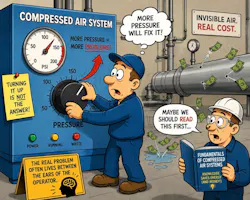
Besides leaks, one of the most overlooked sources of compressed air waste is the lack of understanding of the people operating the system. The problem often isn’t the compressors, it’s “between the ears” of the operator.
A person complains once, someone turns the pressure up “just to be safe,” and suddenly the entire system is using far more energy than necessary. Another compressor gets left running because “that’s how we’ve always done it.”
Compressed air systems are full of invisible traps for the untrained. Higher pressure feels like a solution, but it often creates artificial demand and drives up energy costs. Most operators mean well, but without proper training, efficient systems slowly become expensive noise-making machines. Sometimes the best energy-saving upgrade isn’t new equipment, it’s upgrading the knowledge between the operator’s ears.
Do you want help in finding out what to do to reduce your system’s operating costs? Compressed Air Challenge’s Fundamentals and Advanced training can help you formulate a plan. More information is on the Compressed Air Challenge website.