Case Study: Redimix cuts year-over-year maintenance spend by more than half with a single source of truth
Key Highlights
- Redimix adopted MaintainX CMMS to centralize data, standardize procedures, and improve maintenance tracking across multiple sites.
- The company achieved a 53.9% reduction in maintenance costs and a 66% decrease in winter maintenance expenses, while increasing work order throughput.
- Enhanced visibility into work statuses and inventory allowed better prioritization, planning, and faster repair decisions, reducing unplanned downtime.
- Standardized training and knowledge capture fostered a proactive maintenance culture.

Redimix Companies, the leading concrete supplier in New Hampshire and Southern Maine, is no stranger to challenging projects. Its selection to help modernize a U.S. Navy shipyard in Kittery, Maine, including providing about 160,000 cubic yards of concrete over six years, represents the second largest ready-mix concrete job in the history of the Northern New England region.
With stringent quality control and reliable schedule performance critically important to the project’s success, the concrete company took the opportunity to elevate its reliability and maintenance processes to minimize any disruptions to its production operations.
Greg Wortman, who joined Redimix Companies as operations manager in 2021, made identifying and resolving challenges that might interfere with the Redimix team’s performance a primary goal. “It’s not about cost cutting. It’s about training your team and maintaining your equipment so that you don’t incur the costly downtime,” he explains.
Consolidating on the MaintainX computerized maintenance management system (CMMS), standardizing procedures, and improving training, tracking, and forecasting helped to reduce year-over-year maintenance costs by 53.9% and winter maintenance costs by 66%, while completing more maintenance work orders than ever before.
Scattered data and knowledge gaps impeded maintenance performance
Redimix, like many companies, made use of spreadsheets, sticky notes, and employees’ memories in its prior maintenance processes. Team members lacked ready visibility into work order statuses and how many were opened or completed, and technicians were bouncing between sites firefighting problems.
Knowledge gaps in inventory accounting, vendor performance, and parts and repair costs hindered decision making and forecasting of reliability and maintenance (R&M) spend. Data was lacking to accurately track and improve key performance indicators such as overall equipment effectiveness (OEE) and mean time to repair (MTTR).
A central knowledge hub was needed to capture institutional knowledge and quality data, enabling consistent training and development of a preventive maintenance culture and increasing resilience to the challenges of turnover.
“I wanted information out of people's heads,” Wortman says. “I wanted an evergreen system so it wouldn’t matter if I left or if my maintenance people left.”
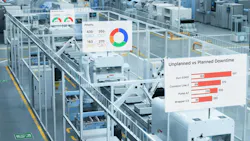
CMMS platform search focused on driving maintenance optimization
The pressing need for a single source of truth compelled the search for a CMMS solution that maximized usability, mobility, consistency, and visibility. The solution needed an intuitive, user-friendly interface to hasten adoption by users with varying roles and levels of expertise, and a mobile-first design with both online and offline capabilities.
Support for new, standardized procedures in the central knowledge repository was essential to drive consistency in training, operations, and maintenance, and to widen Redimix’s applicant pool to technicians suited for in-house training and upskilling.
Providing clear visibility into work statuses at each plant was required to better prioritize, plan, and schedule maintenance resources and prevent equipment failures. Comprehensive inventory and vendor tracking capabilities were necessary to deliver parts planning and cost efficiencies and accelerate repair or replace decisions in the event of equipment failure.
Timely proactive maintenance saves costs while increasing uptime and profit margins
Redimix completed nearly 1,800 maintenance work orders with MaintainX in the two years following its 2023 implementation, yielding a nearly 54% reduction in year-over-year maintenance spend, including a 66% reduction in winter maintenance costs.
“We’ve done more maintenance than we’ve ever done before—with a significant cost reduction. This means we’ve been able to expand our profit margin,” Wortman says. “The scheduling portion of this software was a massive win for us—there were no more dumpster fires.”
Eliminating dependency on spreadsheets was a major accomplishment. “I don't have to dig through a dozen reports. If I want to pull the data up on my phone right now, I can take a look at all of those dashboards with the click of a button,” Wortman explains.
Enhanced tracking of parts, work orders, costs, and metrics such as OEE and MTTR contributed to significant maintenance efficiency gains and reduced unplanned downtime. Additionally, new standard operating procedures and enhanced knowledge capture improved training and facilitated the transition from reactive to proactive maintenance.
“It’s not about cost cutting. It’s about training your team and maintaining your equipment so that you don’t incur the costly downtime,” Wortman observes. “I’m excited to have the intuitive software at my fingertips and to see how much value it's bringing us.”
Further gains are envisioned from advanced technology innovations
Wortman sees opportunities to continue advancing maintenance operations through technology, including sensors to improve predictive maintenance and emerging AI tools for time and cost efficiencies.
Today, the new CMMS provides Redimix with the data to understand why costs move the way they do. “That data foundation is exactly what makes the next step with AI so promising,” believes Nick Haase, co-founder of MaintainX.
“Greg is already asking whether AI can look at customer demand, downtime patterns, and capacity to identify the optimal window for planned maintenance. It's the right question," Hasse notes. “For teams that have done the work to digitize their operations, that answer is getting closer every day.”
About the Author
 Sheila Kennedy
Sheila Kennedy
CMRP
Sheila Kennedy, CMRP, is a professional freelance writer specializing in industrial and technical topics. She established Additive Communications in 2003 to serve software, technology, and service providers in industries such as manufacturing and utilities, and became a contributing editor and Technology Toolbox columnist for Plant Services in 2004. Prior to Additive Communications, she had 11 years of experience implementing industrial information systems. Kennedy earned her B.S. at Purdue University and her MBA at the University of Phoenix. She can be reached at [email protected] or www.linkedin.com/in/kennedysheila.