Case study: Syngenta boosts industrial pump efficiency with ITT VIDAR variable-speed motor
Key Highlights
- VIDAR motors eliminate the need for external VFDs, saving space and reducing installation time from weeks to hours.
- The embedded technology reduces energy consumption by enabling precise, automatic speed control based on process demand.
- Installation costs are lowered by 40-50%, and maintenance issues like overheating, vibration, and noise are significantly reduced.
- Syngenta plans to expand the use of VIDAR motors, further increasing energy savings and operational reliability across their plant.
- The technology supports the potential removal of control valves, leading to enhanced efficiency, lower maintenance, and simplified system design.

Chemical processing environments demand equipment that operates reliably under tough conditions, especially when abrasive or variable-load fluids are involved. At Syngenta, a chemical company serving the agricultural market, a chlorinator pump that is responsible for transferring a neutralized waste stream containing lime grit was driven by a motor exhibiting the classic symptoms of a fixed-speed motor driving a process that actually needed variable flow control: high vibration, elevated noise, overheating, and repeated overload shutdowns.
Downstream, a control valve was restraining flow to match process demands, but the restriction forced the pump and motor to operate above their design point. “We have multiple pumps that have flow control valves used to restrict flow on the discharge of the pump. This caused our pumps to run inefficiently, as well as create excessive sound and vibration,” says Justin David, maintenance engineer at Syngenta.
The fixed-speed motor was rated at 30 hp but was routinely drawing up toward 33 hp under load, causing excessive current draw, overheating, and wasted energy. Even worse, the overheating frequently shutdown operations, increased system maintenance costs, and reduced overall system reliability.
The control valve downstream of the chlorinator pump was consistently closed at 40%, and the restricted flow caused the pump motor to draw 40 amps instead of the expected 35. This generated excess heat that was shortening motor lifespan by up to 50%. The restricted flow was also causing turbulence, driving noise levels to 105 dB and creating a hazardous work environment at the plant.
The problem with VFDs: space, hardware, and installation time
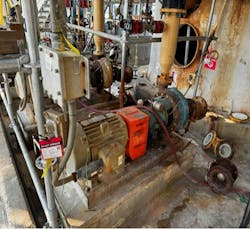
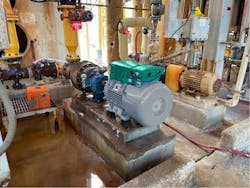
A traditional variable frequency drive (VFD) would solve the problem but would also require weeks of downtime for rewiring and an additional enclosure. Instead, Syngenta swapped the existing motor (Figure 1) for a VIDAR motor from ITT, which has variable-speed intelligence embedded into the motor (Figure 2). This eliminates the space needed for an external VFD, and it also doesn’t require specialized inverter-duty cables and power conditioning or filtering.
“Due to the space that a traditional VFD takes in the MCC [motor control center] this provides a good alternative to space restrictions,” says Logan Prather, reliability engineer at Syngenta.
Syngenta’s situation is a common challenge that ITT heard from other industry customers: using control valves to modulate flow generates unnecessary mechanical stress and energy waste. Also, ITT found that customers that needed or wanted a VFD often didn’t have the space for it. This type of embedded variable speed solution has been done in the commercial space, says Dan Kernan, vice president and general manager of VIDAR at ITT, but the VIDAR motor is geared specifically toward industrial use.
“It all started with that customer challenge,” Kernan says. He estimates that ITT customers use VFDs on 10-15% of their pumps and fans, but it should be more like 50-60%. “There was this gap in the current technology,” he adds.
ITT launched the VIDAR motor in March 2025 and starting shipping product in July, but the company has been working on the project for almost six years. This includes putting the motors out in the field with pilot plants over the last few years. “These are pretty challenging environments. We’re in chemical plants and pulp and paper plants, general and wet corn milling, biofuels. We wanted to make sure it would last,” Kernan says.
Not only did Syngenta save space and hardware costs, installation time was also greatly reduced. “We installed a single VIDAR motor with two traditional I/O wires that ran back to the DCS [distributed control system],” says David with Syngenta.
VIDAR can integrate with an existing DCS, programmable logic controller (PLC) or supervisory control and data acquistion (SCADA) system for centralized control that can maintain compatibility with legacy MCCs.
Without the external equipment, the swap was as simple as a standard motor replacement, taking only a few hours. By comparison, a conventional VFD installation for this project would have taken four to six weeks. Syngenta also saved 40-50% on the overall cost without inverter-duty cables, enclosures, and wiring modifications, compared to a traditional VFD installation.
AC-Link technology shrinks VFD footprint for industrial applications
“The main driver for overall VFD size is the need to reduce the heat generated from the VFD inside the panel. There is a dc bus that makes the conversion from ac to dc voltage. We removed this dc section, which minimized the heat within the VFD, allowing us to reduce the typical 200-pound VFD to 33 pounds,” says Michael Pethers, director of sales for VIDAR at ITT.
Despite the smaller form factor, size was the first engineering hurdle, Pethers says, as it needed to embed the patented AC-Link technology into the same size as a NEMA frame induction motor, and ITT met that challenge in order to make drop-in replacement possible.
A normal VFD converts ac power to dc, then back to ac. “That dc stage requires big electrolytic capacitors, and it’s pretty bulky,” Kernan says. With the AC-Link technology, the VIDAR motor removes the dc stage entirely, which shrinks the VFD by about 60%. “Now we could integrate it into the motor at much higher power levels and also put it into a package that was built for industrial environments,” Kernan adds.
Kernan says that plant customers also point to electrolytic capacitors as a common failure point in VFDs, so it’s also providing a reliability advantage. VFDs, or any power conversion technology, can also add current harmonic distortion or electrical noise to the system, so VIDAR eliminates that disturbance as well.
The one disadvantage to the technology, Kernan notes, because it’s switching from the ac waveform, and not dc, you don’t get full voltage out of it. “It only has full voltage at one point in the sine wave. You only get about 85% of the voltage out,” Kernan says. As long as the motor is designed for that, it should run without any issues and still provide vast energy advantages.
Syngenta’s phased integration unlocks maximum energy efficiency, more than $10K in annual savings
Once installed, Syngenta ran VIDAR in manual mode to adjust the speed while keeping the current control valve logic in place. After testing different speeds, they settled on 1600 RPM, which reduced power demand from 33 hp to 28 hp. The motor current draw also dropped by 30% from 40 amps to 28 amps, under lower power demand.
While this was a quick fix to the problem, the new motor could ultimately provide even greater efficiency gains by fully integrating VIDAR into the plant’s control system. Once the system made automatic speed adjustments, based on demand, Syngenta could reduce pump motor RPMs to 1,160, horsepower to 19.9, and motor current to 20 amps. This resulted in an overall energy savings of $10,041 per year.
Next, the plant eliminates the control valve entirely, which unlocks even greater efficiency, cost savings, and system reliability.
Kernan says many flow control valves could be eliminated with smart variable speed control. “With a control valve, you’re restricting the flow,” he adds. “Anytime you’re throttling it, you are essentially breaking down pressure, so if you can eliminate that you’re going to be much better off from an energy consumption but also reliability standpoint. If you have the opportunity to go variable speed, you don’t really need the control valve in most cases.”
Completely removing the valve is new and maybe uncomfortable for some facilities, Kernan notes. To start, they leave the valve as is, but completely open, so facilities can gain some comfort with the system, before actually removing the valve completely. The removal would also mean less valve maintenance in the long term.
Industrial facilities often face a familiar challenge: maintaining energy efficiency and reliability while managing space, complexity, and maintenance burdens. For Syngenta, VIDAR delivered a fast, low-disruption solution to chronic pump inefficiencies. By embedding smart variable-speed control directly into the motor, VIDAR simplified installation, reduced energy demand, minimized maintenance issues, and improved operational reliability.
From an MRO standpoint, the immediate gains were evident: reduced vibration, reduced noise, no overload or overheating events, and far fewer manual adjustments to the control valve. “Efficiency has increased along with removing the swinging control valves. This has reduced turbidity in the process and will prevent future maintenance issues,” David says.
VIDAR has also removed noise and vibration in the discharge piping of the pump, improving working conditions and equipment efficiency. With the success of the first installation, Syngenta had plans to install six more VIDAR motors by the end of the year, multiplying its energy savings without compromising precious space on the plant floor.
About the Author
 Anna Townshend
Anna Townshend
head of content
Anna Townshend is the chief editor and head of content for Plant Services. She has been a journalist and editor for more than 20 years and joined Plant Services and Control Design as managing editor in June 2020. Previously, for more than 10 years, she was the chief editor of Marina Dock Age and International Dredging Review. In addition to writing and editing thousands of articles in her career, she has been an active speaker on industry panels and presentations, as well as host for Great Question: A Manufacturing Podcast. Email her at [email protected].