Why firefighting is the superior maintenance and turnaround strategy
Key Highlights
- Firefighting maintenance increases downtime, costs, and stress while masking deeper reliability and planning issues.
- Reactive maintenance culture often replaces strategy, data, and accountability with urgency and blame.
- Emergency repairs may feel efficient, but they significantly inflate long-term maintenance and production costs.
Welcome to the world of firefighting in maintenance, where chaos is not just an occasional visitor but a cherished and well-cultivated resident.
Firefighting is the maintenance philosophy of legends, the secret sauce that keeps our plants and facilities operating in a perpetual state of crisis. Who needs structured plans, preventive care, or reliability engineering when you can have the thrill of “fixing it when it breaks”? After all, nothing says “we’re on top of it” like a dedicated maintenance team scrambling to duct-tape machinery while production grinds to a halt.
Let’s be honest: firefighting is exhilarating. There’s a certain je ne sais quoi to sprinting down hallways with a wrench in hand and a look of sheer panic on your face. The tension, the drama, the adrenaline! Can a well-maintained system give you that? Can a proactive maintenance strategy offer the same gut-wrenching thrill of unexpected machinery failure right in the middle of peak production? Of course not. And that’s exactly why firefighting is the superior maintenance strategy. Predictable, efficient systems are for wimps. Real maintenance professionals thrive in an environment where the next disaster is just around the corner.
Let’s talk about planning. Sure, some maintenance teams waste time on preventative maintenance schedules, CMMS data, and predictive analytics. But where’s the fun in that? Firefighting eliminates the need for pesky “plans” or “data.” Instead, we embrace a Zen-like state of readiness to drop everything at a moment’s notice. Why bother with regular inspections or aligning components when we can wait until something is visibly smoking before jumping in to save the day? If it isn’t on fire, it’s clearly doing fine. And when it does catch fire, it just proves how necessary we are. Firefighting: it’s job security with a side of suspense.
But let’s not overlook the economic genius behind firefighting. Regular maintenance? That costs money, my friends. All that “routine” checking and fixing? That’s a budget black hole. Firefighting, on the other hand, is refreshingly simple. You just wait until the equipment fails catastrophically, and then you spend three times the budget on emergency repairs. This is called cost efficiency, folks. Sure, you might have higher downtime costs, expedited shipping fees, and emergency contractor rates, but think of the cost savings on planning and training. Besides, our accountants love the chaos of unpredictable budget spikes—it keeps them on their toes!
Another major perk of firefighting is that it requires no real strategy. You don’t need any of those complicated maintenance frameworks or time-consuming training programs. Why teach someone how to properly maintain equipment when you can just teach them how to react in a crisis? In fact, our entire onboarding process consists of teaching new hires to recognize the sound of a machine failing, followed by a quick overview on where the spare duct tape is kept. Because in firefighting, it’s not about preventing problems; it’s about surviving them.
Of course, no firefighting maintenance strategy would be complete without the star of the show: blame-shifting. In firefighting, everything is someone else’s fault. Did a bearing fail catastrophically? That’s on the operator for not hearing the “obvious” grinding noise three weeks ago. Did a conveyor belt snap mid-shift? Clearly, that’s engineering’s fault for not building it sturdier. Firefighting is built on the art of pointing fingers and feigning shock—“Who could have seen this coming?” becomes our rallying cry. In a firefighting culture, accountability is for suckers.
And let’s not forget the team morale boost. Nothing unites a team like the shared experience of constant stress and late-night emergency calls. When your team is accustomed to the 3 a.m. phone call about an explosion in Section 5, they’re bonded for life. Preventative maintenance might promote a healthy work-life balance, but where’s the camaraderie in that? Firefighting gives us shared trauma, sleep deprivation, and a wonderful sense of impending doom. We’re not just co-workers; we’re brothers and sisters in arms, forged in the fires of unplanned shutdowns and frenzied parts scavenging.
In the end, firefighting isn’t just a maintenance strategy—it’s a lifestyle. It’s the art of showing up heroically after everything has gone wrong and pretending that this is all just business as usual. It’s the commitment to never learn from the past because there’s always another crisis waiting in the wings. So let’s keep our maintenance strategy chaotic, reactive, and unpredictable. Because in the world of firefighting, we’re not just fixing machines—we’re living on the edge.
About the Author
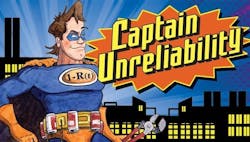
Captain Unreliability
Captain Unreliability is a satire of the state of the manufacturing industry in ’Merica today and is written by an industry professional known for using humor to get the point across. Stay tuned for more useless advice, and if you have topics you’d like to see covered or questions you’d like The Captain to weigh in on, contact The Captain directly at [email protected] or follow on Twitter @CUnreliability. Also, consider becoming Unreliable today by getting your Captain t-shirt at https://reliabilityx.com/product-category/gear.